Legislation to strengthen U.S. fiscal health and stabilize the nation’s finances draws widespread support
WASHINGTON—U.S. Senators John Curtis (R-UT) and Angus King (I-ME) today announced key stakeholder support for their Fiscal Commission Act. The legislation, introduced earlier this month, would create a bipartisan, bicameral fiscal commission tasked with finding legislative solutions to stabilize spending and decrease the national debt, which now exceeds $38.8 trillion. Joining Curtis and King as cosponsors of the legislation are Senators Thom Tillis (R-NC), Chris Coons (D-DE), Todd Young (R-IN), Tim Kaine (D-VA), Bill Cassidy (R-LA), Jeanne Shaheen (D-NH), Kevin Cramer (R-ND), and Mark Warner (D-VA).
What They Are Saying:
“Congress should review and update activities throughout the federal budget. A well-designed fiscal commission like Senators Curtis and King’s Fiscal Commission Act can help Congress rebuild trust, start looking at everything, and move toward more responsible stewardship. Ideally, it would lay the foundation for Congress to embrace a more holistic and effective regular order for budgeting.” — Americans for Prosperity, Kurt Couchman, Senior Fellow in Fiscal Policy
“The growing national debt is raising costs for American families, while federal interest payments on our debt are crowding out our ability to invest in critical programs. This unsustainable dynamic risks further weakening the U.S. economy if Congress fails to act. BPC Action applauds Senators Curtis, King, Tillis, Coons, Young, Kaine, Cassidy, Shaheen, Cramer, and Warner for leading the Fiscal Commission Act and urges Congress to pass this legislation, which will bring together federal policymakers and experts to negotiate achievable ideas to rein in deficits that both sides can advance.” — Bipartisan Policy Center Action, Michele Stockwell, President
“I commend Senators John Curtis (R-UT) and Angus King (I-ME) for introducing the Senate companion to the bipartisan House Fiscal Commission Act, championed by Representatives Bill Huizenga (R-MI) and Scott Peters (D-CA). With interest costs on America’s debt exceeding what the government spends on national defense, as debt is on track to exceed the size of the U.S. economy next year, it is urgent that members of Congress address the growing US debt crisis, before bondholders force legislators to take far worse austerity measures or push the Fed to allow inflation to run rampant.” — Cato Institute, Romina Boccia, Director of Budget and Entitlement Policy
“We’re more indebted today as a share of the economy than we’ve ever been outside of a war. Now more than ever, we need a bipartisan commission to address our unsustainable fiscal path. We need a venue where honest dialogue can occur, where our elected officials can talk to—not past—each other, and where the difficult but necessary choices of budgeting are allowed to finally happen. A bipartisan commission creates the opportunity for lawmakers to begin fixing the debt. We commend Senators Curtis (R-UT) and King (I-ME), along with all the other cosponsors of the Fiscal Commission Act, for taking this important step toward fiscal sanity.” — Committee for a Responsible Federal Budget, Maya MacGuineas, President
“Financing our $38 trillion debt is driving up interest costs, crowding out private investment, and increasing the risk of inflation and long-term economic stagnation. If left unchecked, it threatens our economic stability and national security. A bipartisan fiscal commission with meaningful authority and expedited consideration of its recommendations can help break through the gridlock that has stalled progress for too long. We thank lead sponsors Senators John Curtis and Angus King as well as the eight bipartisan cosponsors for championing the bipartisan Fiscal Commission Act. With a companion bill already introduced in the House that has garnered more than 40 bipartisan cosponsors, Congress has a real opportunity to confront our nation’s growing debt.” — Concord Action, Dr. Carolyn Bourdeaux, Executive Director
“With the national debt as large as our entire economy and Social Security facing insolvency, we need a dedicated approach to solving our fiscal challenges. A bipartisan fiscal commission would enable lawmakers to develop a comprehensive plan to secure our nation’s economic future. As interest costs now exceed $1 trillion per year, the time to act is now—for the next generation.” — Peter G. Peterson Foundation, Michael A. Peterson, CEO
“PPI commends Senators King and Curtis for introducing the Fiscal Commission Act. Creating a bipartisan fiscal commission is a commonsense step toward addressing our long-term budget challenges. While it won’t solve the problem overnight, it provides a structured forum for lawmakers to discuss practical, sustainable solutions before the cost of inaction grows even larger.” — Progressive Policy Institute, Ben Ritz, Vice President of Policy Development
“Rapidly rising interest costs, looming Social Security and Medicare trust fund shortfalls, and inadequate tax revenues all underscore the urgent need for a fiscal commission. Putting our fiscal house in order will also help lower interest rates and ease inflation. Senators Curtis (R-UT) and King’s (I-ME) Fiscal Commission Act is a critical step toward addressing our nation’s long-term fiscal challenges.” — Third Way, Zach Moller, Senior Director of the Economic Program
“Lawmakers must get serious about the unsustainable path our national debt is on. We cannot keep kicking the can down the road and leaving the next generation to pay the bill. The Fiscal Commission Act offers a commonsense, bipartisan, bicameral way to bring Democrats and Republicans to the same table, level with the American people about the tough choices ahead, and put forward balanced, responsible solutions that protect working families and put our fiscal house in order. But this effort must lead to real action—not just another report that gathers dust.” — Former Senator Joe Manchin
“It is unconscionable for the U.S. to continue unchecked borrowing and leave the bill for our grandchildren to pay. We must be honest about the unsustainable path we’re on and take action. The Fiscal Commission Act would bring both parties together to start working on real bipartisan solutions before it’s too late, and I appreciate the leadership of Senators Curtis and King to advance this legislation.” — Former Senator Mitt Romney
Background:
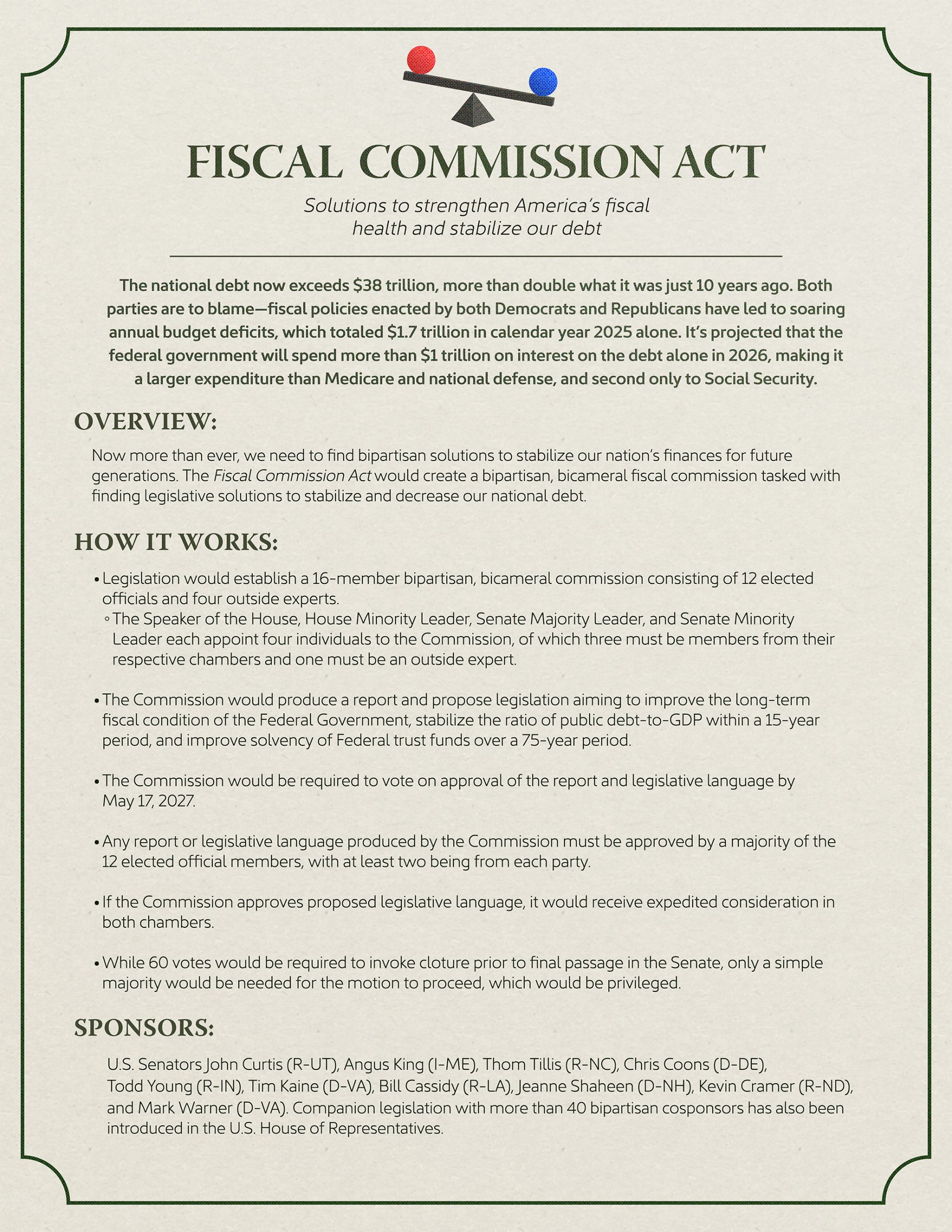
The national debt now exceeds $38.8 trillion, which is approximately 124% of the entire U.S. economy. Both parties are to blame—fiscal policies enacted by both Democrats and Republicans have led to soaring annual budget deficits, which totaled $1.7 trillion in calendar year 2025 alone. It’s projected that the federal government will spend more than $1 trillion on interest on the debt alone in 2026, making it a larger expenditure than Medicare and national defense, and second only to Social Security.
The Fiscal Commission Act:
- The legislation would establish a 16-member bipartisan, bicameral commission consisting of 12 elected officials and four outside experts.
- The Speaker of the House, House Minority Leader, Senate Majority Leader, and Senate Minority Leader each appoint four individuals to the Commission, of which three must be members from their respective chambers and one must be an outside expert.
- The Commission would produce a report and propose legislation aiming to improve the long-term fiscal condition of the Federal Government, stabilize the ratio of public debt to GDP within a 15-year period, and improve the solvency of Federal trust funds over a 75-year period.
- The Commission would be required to vote on approval of the report and legislative language by May 17, 2027.
- Any report or legislative language produced by the Commission must be approved by a majority of the 12 elected official members, with at least two being from each party.
- If the Commission approves proposed legislative language, it would receive expedited consideration in both chambers.
- While 60 votes would be required to invoke cloture prior to final passage in the Senate, only a simple majority would be needed for the motion to proceed, which would be privileged.
The full text of the bill can be found here, and a one-pager can be found here.